6 Best VHF Marine Radios for Boat Options for Sailors (2026)
Compare the best vhf marine radio for boat options for sailors. See which fixed and handheld VHF radios suit dinghy, cruising, and weather-alert needs.
 By Graham Fisher
Updated November 21, 2026
 By Graham Fisher
Updated November 2026
Choosing a vhf marine radio for boat use comes down to a few practical questions: fixed mount or handheld, how much transmit power you need, whether it carries NOAA weather alerts, and whether it has Digital Selective Calling (DSC) for distress. The picks below are based on product listings, brand reputation, and patterns in owner feedback rather than hands-on testing. Each one is a marine VHF with US, Canadian, and international channels unless noted.
Our top picks at a glance
- 1TOP CHOICEBest overallUniden UM385 Marine VHF Radio, 25-Watt Fixed Mount, IPX4 Waterproof, WhiteView on Amazon
- 2
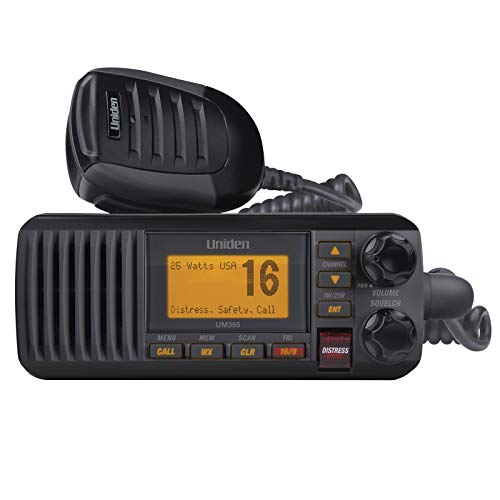 TOP CHOICEBest for budget installsUniden UM385BK 25 Watt Fixed Mount Marine VHF Radio, Waterproof, Noaa Weather AlertView on Amazon
- 3
 TOP CHOICEBest for advanced channel accessUniden UM435BK Advanced Fixed Mount VHF Marine RadioView on Amazon
- 4Best for a large display and GPSUniden UM435BK Advanced Fixed Mount VHF Marine RadioView on Amazon
- 5
 Best for a waterproof fixed mountUniden UM725 Marine VHF RadioView on Amazon
- 6
 Best handheld backupCobra BlueBound 350 VHF Handheld Marine RadioView on Amazon
- 7
 Best for GPS-equipped cockpit useUniden UM725GBK Marine VHF Radio, All USA, Canada, and Intl. Marine ChView on Amazon
Our Top Picks
Quick Comparison
| Product | Best for | Key feature |
|---|---|---|
| Uniden UM385 Marine VHF Radio | Best overall | DSC distress button, triple watch |
| Uniden UM385BK 25 Watt Fixed Mount | Budget installs | 25-watt fixed mount, NOAA alerts |
| Uniden UM435BK Advanced Fixed Mount | Advanced channel access | IPX8 submersible, 4-digit channels |
| Uniden UM725G Marine VHF Radio | Large display and GPS | Largest LCD in class, built-in GPS |
| Uniden UM725 Marine VHF Radio | Waterproof fixed mount | IPX8 waterproof, speaker mic |
| Cobra BlueBound 350 VHF Handheld | Handheld backup | Floats, IPX7, USB-C charging |
| Uniden UM725GBK Marine VHF Radio | GPS-equipped cockpit use | Built-in GPS, speaker mic |
Uniden UM385 Marine VHF Radio, 25-Watt Fixed Mount, IPX4 Waterproof, White
Uniden UM385 Marine VHF Radio, 25-Watt Fixed Mount, IPX4 Waterproof, White | All USA/Intl./Canadian Marine Channels, NOAA Weather Alerts, Triple Watch, DSC (Digital Selective Calling) Distress Button
Best for: Best overall
A straightforward fixed-mount radio for sailors who want DSC distress calling and reliable everyday channel access.
Pros
- DSC distress button and triple watch function
- NOAA weather alerts included
Cons
- IPX4 rating is splash-resistant, not submersible
Uniden UM385BK 25 Watt Fixed Mount Marine VHF Radio, Waterproof, Noaa Weather Alert
Uniden UM385BK 25 Watt Fixed Mount Marine VHF Radio, Waterproof, Noaa Weather Alert, All USA/Intl/Canadian Marine Channels
Best for: Budget installs
Suits owners who want a no-frills 25-watt fixed radio for a day sailer or small cruiser.
Pros
- 25-watt output for longer range
- Covers USA, Canadian, and international channels
Cons
- Fewer advanced features than the newer models
Uniden UM435BK Advanced Fixed Mount VHF Marine Radio
Uniden UM725G Marine VHF Radio, All USA, Canada, and Intl. Marine Channels, 1Watt/25Watt Transmit Power, Largest LCD Screen in Class, NOAA Weather Channels w/Alerts, Speaker Mic, GPS Built-in.
Best for: Advanced channel access
Fits sailors who cruise in Canadian waters or need the expanded 4-digit and “B” channels.
Pros
- IPX8 submersible construction
- Includes new 4-digit and CDN “B” channels
Cons
- More menu depth to learn before first use
Uniden UM725G Marine VHF Radio
Best for: Large display and GPS
A good match for helmsmen who want to read channel and position data at a glance from the cockpit.
Pros
- Largest LCD screen in its class, per the manufacturer
- Built-in GPS and NOAA weather channels with alerts
Cons
- Larger footprint may not fit tight dash openings
Uniden UM725 Marine VHF Radio
Uniden UM725 Marine VHF Radio, All USA, Canada, and Int'l. Marine Channels, 1Watt/25Watt Transmit Power, Largest LCD Screen in Class, NOAA Weather Channels w/Alerts, Speaker Mic, IPX8 Waterproof.
Best for: Waterproof fixed mount
For owners who want the same large display without built-in GPS and need solid water protection.
Pros
- IPX8 waterproof rating
- Speaker mic for convenient handling
Cons
- No built-in GPS
Cobra BlueBound 350 VHF Handheld Marine Radio
Cobra BlueBound 350 VHF Handheld Marine Radio – White, 6-Watt, Floats | Long Range, NOAA Weather Alerts, International Functionality, IPX7 Waterproof, USB-C, Submersible, LCD Screen, Belt Clip
Best for: Handheld backup
A portable radio for the dinghy, tender, or as a second unit if the fixed set fails.
Pros
- Floats and carries IPX7 waterproof rating
- USB-C charging and NOAA weather alerts
Cons
- Lower transmit power than a fixed-mount 25-watt set
Buying Guide
Fixed Mount vs. Handheld
A fixed mount radio is wired into your boat’s power system and typically offers higher transmit power and a larger antenna setup, making it the better choice for offshore or longer-range use. A handheld radio is portable, runs on battery, and works well as a backup, for dinghies, or for use on deck and in the cockpit.
Many sailors carry both, using the fixed mount as the primary station and a handheld for emergencies or going ashore.
Transmit Power
Most marine VHF radios offer a low setting of about 1 watt and a high setting of about 25 watts for fixed mounts. Lower power is useful for conserving battery and for short-range contact with nearby vessels, while high power extends your reach. Handhelds usually top out at lower wattage, so plan your range expectations accordingly.
NOAA Weather Alerts and Channel Coverage
NOAA weather channels with alert functionality are valuable for monitoring forecasts and severe weather warnings while underway. Also check that the radio covers US, Canadian, and international marine channels if you plan to cruise beyond home waters.
DSC and Distress Features
Digital Selective Calling (DSC) lets you send a digital distress alert with your position and vessel information at the push of a button. If you want an added layer of safety, look for a radio with a DSC distress button and a built-in or connected GPS so your location can be transmitted automatically.
Waterproofing and Durability
Marine conditions are harsh, so pay attention to the waterproof rating. An IPX4 rating protects against splashing, while IPX7 or IPX8 ratings indicate greater submersion protection. For handhelds that may end up overboard or on wet decks, a higher rating offers more peace of mind.
FAQ
Do I need a license to use a marine VHF radio?
In the United States, recreational boaters do not need an operator license to use a VHF marine radio on domestic waters, but a station license is generally required for certain radios and uses. Rules vary by country, so check the requirements for the waters you plan to sail. Taking a course such as the Short Range Certificate is a good way to learn proper procedures.
What is the difference between channel 16 and the other channels?
Channel 16 is the international distress, safety, and calling channel, and it should be monitored whenever you are underway. The other channels are used for working communications, such as talking to other vessels, marinas, or bridges. Using Channel 16 only for calling and then switching to a working channel keeps it clear for emergencies.
Is DSC required on a marine VHF radio?
DSC is not required for all recreational boats, but it is strongly recommended because it allows automated distress alerts that can be received by other vessels and coast stations. Radios with a DSC distress button make it easier to send an alert quickly in an emergency. Make sure to register your MMSI number if your radio uses DSC.
Can a handheld marine radio replace a fixed mount?
A handheld can serve as a useful backup or supplement, but it generally has lower transmit power and a shorter effective range than a fixed mount with an external antenna. For primary communications on a cruising boat, a fixed mount is usually the better choice. Keeping a handheld charged and stowed in an accessible place is a good safety practice.
How do I know which radio is right for my boat?
Start by considering where you sail, how far offshore you go, and whether you want features like NOAA alerts, GPS, or DSC. Match the wattage and mounting style to your boat’s layout and power system. Budget and the waterproof rating should also factor into your decision.
Conclusion
For most sailors who want a reliable primary radio, a fixed mount model with DSC, NOAA alerts, and wide channel coverage is the best fit, especially for cruising or offshore passages. Budget-minded boaters on coastal or inland waters can get solid performance from a simpler fixed mount with the essentials.
If you want portable backup or a dinghy radio, a waterproof handheld with a long-range rating and built-in features is a practical addition. Many boaters find that pairing a fixed mount with a handheld gives them the most coverage and peace of mind.
Related reading
- VHF Marine Radio Aerials: How to Choose, Mount and Test One (2026)
- Garmin VHF 215 AIS Marine Radio: Setup and Use Guide (2026)
- 4 Best Standard Horizon VHF Marine Radios for Boaters (2026)
About Graham Fisher
Graham Fisher is part of our editorial team and reviews and edits our sailing gear guides, checking product details against manufacturer specifications and owner feedback.
About the author
Graham Fisher writes reviews and buying guides for Sailing The Web.