6 Best Icom VHF Handheld Marine Radio Picks for Boaters (2026)
Compare six icom vhf handheld marine radio models for boating and sailing. See which Icom VHF handheld fits your needs, from floating units to DSC and AIS.
 By Graham Fisher
Updated November 22, 2026
 By Graham Fisher
Updated November 2026
Choosing an icom vhf handheld marine radio comes down to a few practical questions: Does it float if you drop it overboard? Does it have DSC for distress calls? Will the battery last a full day on the water? This list compares six Icom and related handheld VHF models based on manufacturer specifications, listing details and common owner feedback patterns, with an eye on waterproofing, power output, battery life, and extra features like AIS reception.
Our top picks at a glance
- 1TOP CHOICEBest overallIcom M25EVO Blue Marine VHF RadioView on Amazon
- 2
 TOP CHOICEBest for weather alertsCobra BlueBound 350 VHF Handheld Marine Radio, BlackView on Amazon
- 3
 TOP CHOICEBest for AIS awarenessIcom M94D 21 USA VHF Marine Transceiver with DSC & AIS ReceiverView on Amazon
- 4
 Best for floating recoveryIcom IC-M37 31 USA VHF Marine Transceiver Radio with Float'n FlashView on Amazon
- 5
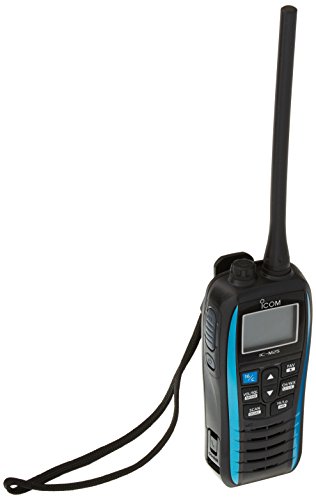 Best for simple, budget-minded useIcom IC-M25 21 Handheld VHF Radio, Blue TrimView on Amazon
- 6
 Best for higher outputIcom IC-M73 01 Handheld VHF Marine Radio, 6 WattsView on Amazon
Our Top Picks
| Product | Best for | Key feature |
|---|---|---|
| Icom M25EVO Blue | Overall use | Floating, waterproof, USB charging |
| Cobra BlueBound 350 | Weather alerts | NOAA alerts, IPX7 rating |
| Icom M94D 21 USA | AIS awareness | DSC and AIS receiver |
| Icom IC-M37 31 USA | Floating recovery | Float’n Flash, 6-watt |
| Icom IC-M25 21 | Simple use | Straightforward handheld design |
| Icom IC-M73 01 | Higher output | 6-watt transmit power |
Icom M25EVO Blue Marine VHF Radio
Icom M25EVO Blue Marine VHF Radio | Floating | Waterproof | USB Charging | Lightweight | Long Battery Life | Boating Essentials
Best for: Overall use
A solid all-around choice for dinghy sailors and day cruisers who want a floating, waterproof radio that charges over USB.
- Pros: Floats if dropped overboard; USB charging
- Pros: Lightweight with long battery life
- Cons: Fewer advanced features than DSC-focused models
Cobra BlueBound 350 VHF Handheld Marine Radio, Black
Cobra BlueBound 350 VHF Handheld Marine Radio, Black – 6-Watt, Floats | Long Range, NOAA Weather Alerts, International Functionality, IPX7 Waterproof, USB-C, Submersible, LCD Screen, Belt Clip
Best for: Weather alerts
Suits boaters who want NOAA weather alerts and an IPX7-rated body in one compact unit.
- Pros: NOAA weather alerts; IPX7 waterproof rating
- Pros: Floats and includes a belt clip
- Cons: Brand is less associated with marine radios than Icom
Icom M94D 21 USA VHF Marine Transceiver with DSC & AIS Receiver
Icom M94D 21 USA VHF Marine Transceiver with DSC & AIS Receiver | M94
Best for: AIS awareness
Best for cruisers who want DSC calling and AIS target awareness alongside standard VHF use.
- Pros: DSC and AIS receiver included
- Pros: Standard Icom build quality
- Cons: Setup takes more time than a basic handheld
Icom IC-M37 31 USA VHF Marine Transceiver Radio with Float’n Flash
Icom IC-M37 31 USA VHF Marine Transceiver Radio with Float'n Flash, 6-Watt
Best for: Floating recovery
A good fit for sailors who want a radio that can be found in the water thanks to its built-in flashing light.
- Pros: Float’n Flash feature aids recovery
- Pros: 6-watt output
- Cons: Battery life varies with heavy transmit use
Icom IC-M25 21 Handheld VHF Radio, Blue Trim
ICOM IC-M25 21 Handheld VHF Radio – Blue Trim
Best for: Simple use
For boaters who want a no-frills handheld for routine channel work without extra features to learn.
- Pros: Simple controls
- Pros: Familiar Icom design
- Cons: Fewer modern features than newer models
Icom IC-M73 01 Handheld VHF Marine Radio, 6 Watts
ICOM IC-M73 01 Icom IC-M73 01 Handheld VHF Marine Radio, 6 Watts
Best for: Higher output
Suits boaters who regularly operate in areas where stronger transmit power helps reach other stations.
- Pros: 6-watt transmit power
- Pros: Proven Icom handheld platform
- Cons: Older design than current Icom models
Buying Guide
Waterproofing and floating
Look for an IPX7 or similar rating, which manufacturers specify as withstanding temporary submersion. A radio that floats is far easier to recover after a man-overboard event.
Power output
Most handheld marine radios transmit at up to 6 watts. Higher output can help in some conditions, but antenna height matters more for range.
DSC and AIS features
DSC allows a digital distress call with position data, and AIS reception shows nearby vessels. These are worth paying attention to if you cruise offshore.
Battery life and charging
Check rated battery life and whether the unit charges over USB, which simplifies charging on a boat with limited shore power.
Good picks for this: Icom M25EVO Blue and Icom M94D 21 USA
FAQ
Do all of these Icom handheld VHF radios float?
Not every model in this list is listed as floating, so check the product details before you buy. Models with a float feature are designed to stay on the surface if they fall into the water, which can be a real advantage on a small boat. Even floating radios should be secured with a lanyard or clip so they stay with you.
What does DSC mean, and do I need it?
DSC stands for Digital Selective Calling, which lets you send a digital distress alert with your position and identity to other vessels and the Coast Guard at the press of a button. It is a valuable safety feature for offshore boaters and anyone who wants a faster way to call for help. If you mostly boat in sheltered inland waters, a radio without DSC may still meet your needs.
What is AIS reception, and why would I want it?
AIS, or Automatic Identification System, lets your radio display nearby vessels that are broadcasting their position, speed, and identity. This can help you spot traffic and avoid collisions, especially at night or in busy channels. Receive-only AIS is useful for awareness, but it does not replace a proper chartplotter or radar setup.
How much transmit power do I need on a handheld?
Most handheld marine radios in this lineup use a low-power setting, which is suitable for short-range communication such as talking to nearby boats or a marina. Higher-power settings can extend range, but actual reach depends heavily on antenna height and terrain as much as wattage. Use the high setting when conditions allow, and switch to low power to conserve battery.
How long will the battery last on a full day out?
Battery life varies with how often you transmit, the power level you select, and the battery pack you use. Carrying a spare battery or keeping a charger aboard makes a full day far more manageable. Charging via USB, where supported, is convenient for topping up from a boat’s power source.
Do I need a license to operate a marine VHF radio in the United States?
In the United States, recreational boaters generally do not need an operator license for VHF radios used on domestic waters, but rules can differ for certain uses and other countries. Always check current FCC guidance and any requirements for your specific boating area before heading out. Following correct operating procedures, such as using the proper channels for distress calls, matters regardless of licensing.
Conclusion
If you want a compact, floating, budget-friendly handheld for basic channel communication and safety, the simpler models in this list are a solid choice. Boaters who sail offshore or want the added safety of DSC and AIS awareness should look at the more feature-rich options, such as the M94D or the M37, which are built around those capabilities.
For a balance of portability and everyday use, the M25EVO and the Cobra BlueBound 350 are strong starting points, especially if you value waterproofing and USB charging. Match the radio to how far you travel and how much safety equipment you want on board, and you will end up with a handheld that fits your boat.
Related reading
- VHF Marine Radio Aerials: How to Choose, Mount and Test One (2026)
- Garmin VHF 215 AIS Marine Radio: Setup and Use Guide (2026)
- 4 Best Standard Horizon VHF Marine Radios for Boaters (2026)
About Graham Fisher
Graham Fisher is part of our editorial team and reviews and edits our sailing gear guides, checking product details against manufacturer specifications and owner feedback.
About the author
Graham Fisher writes reviews and buying guides for Sailing The Web.