6 Best Uniden VHF Handheld Marine Radio Models for Boaters (2026)
Compare six Uniden VHF handheld marine radio models by waterproofing, power, weather alerts and battery life to find the right one for your boat.
 By Graham Fisher
Updated November 22, 2026
 By Graham Fisher
Updated November 2026
Choosing a uniden vhf handheld marine radio comes down to a few practical questions: how much water it has to survive, how far you need to transmit, whether it needs NOAA weather alerts, and how long the battery lasts on a full day out. This list compares six Uniden and related handheld units on waterproofing rating, selectable transmit power, GPS and Bluetooth features, and float-or-sink design. Each pick is matched to a specific use case so you can narrow the field quickly.
Our top picks at a glance
- 1
 TOP CHOICEBest overallUniden Atlantis 275 Handheld Two-Way VHF Marine RadioView on Amazon
- 2TOP CHOICEBest for budget-minded boatersUniden MHS75 Waterproof Handheld 2-Way VHF Marine RadioView on Amazon
- 3
 TOP CHOICEBest for longest battery lifeUniden Atlantis 155 Handheld Two-Way VHF Marine RadioView on Amazon
- 4
 Best for GPS and BluetoothUniden MHS338BT Floating Handheld Marine VHF RadioView on Amazon
- 5
 Best for a fixed-mount backupUniden UM385BK 25 Watt Fixed Mount Marine VHF RadioView on Amazon
- 6
 Best for fishing and offshore tripsRetevis RM15 6W Marine Radio VHF IP68 FloatingView on Amazon
Our Top Picks
| Product | Best for | Key feature |
|---|---|---|
| Uniden Atlantis 275 | Overall use | Floating IPX8, large screen |
| Uniden MHS75 | Budget-minded boaters | Selectable 1/2.5/5 watt power |
| Uniden Atlantis 155 | Long battery life | 10-hour battery, NOAA alerts |
| Uniden MHS338BT | GPS and Bluetooth | Built-in GPS, emergency strobe |
| Uniden UM385BK | Fixed-mount backup | 25 watt, waterproof |
| Retevis RM15 | Fishing and offshore | Floating IP68, Tri-Watch |
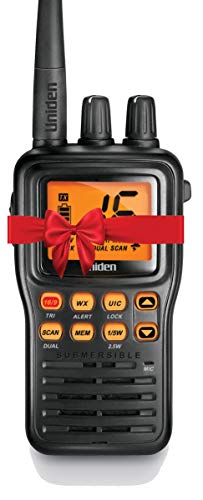
Uniden MHS75 Waterproof Handheld 2-Way VHF Marine Radio
Uniden MHS75 Waterproof Handheld 2-Way VHF Marine Radio, Submersible, Selectable 1/2.5/5 Watt Transmit Power. All USA/International and Canadian Marine Channels.
Best for: Budget-minded boaters who want a submersible radio with adjustable power.
This is a straightforward handheld for day sailors and dinghy crews who mostly talk to nearby vessels and marinas. It covers the USA, international and Canadian marine channels.
Pros
- Selectable 1, 2.5 and 5 watt transmit power to save battery.
- Submersible construction suited to rough conditions.
Cons
- Fewer extras than the newer Atlantis models.
Uniden Atlantis 275 Handheld Two-Way VHF Marine Radio
Uniden Atlantis 275 Handheld Two-Way VHF Marine Radio, Floating IPX8 Submersible Waterproof, Large Dual-Color Screen, 6-Watt, All USA/International/Canadian Marine Channels, NOAA Weather Alerts
Best for: Overall use across coastal cruising and club racing.
The Atlantis 275 suits sailors who want a floating, IPX8 submersible radio with a readable dual-color screen and NOAA weather alerts in one unit.
Pros
- Floating design means it stays afloat if dropped overboard.
- Large dual-color screen is easier to read in glare.
Cons
- Larger body than compact models.
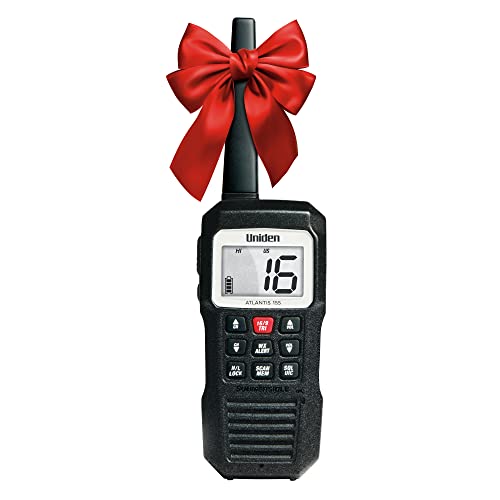
Uniden Atlantis 155 Handheld Two-Way VHF Marine Radio
Uniden Atlantis 155 Handheld Two-Way VHF Marine Radio, Floating IPX8 Submersible Waterproof, Dual-Color Screen, All USA/International/Canadian Marine Channels, NOAA Weather Alert, 10 Hour Battery
Best for: Long days on the water where battery life matters most.
This model is a good match for sailors on extended passages who need reliable coverage without the extra screen size of the 275.
Pros
- Manufacturer specifies about 10 hours of battery life.
- Floating IPX8 body with NOAA weather alert support.
Cons
- Smaller display may be harder to read at a glance.
Uniden MHS338BT Floating Handheld Marine VHF Radio
Uniden MHS338BT Floating, Handheld Marine VHF Radio, 6-Watts, GPS and Bluetooth, Submersible IPX8, Emergency Strobe & Flashlight, NOAA Weather Alerts, FM Radio, Chargeing Cradle & Li-ion Battery.
Best for: Boaters who want GPS and Bluetooth built into a handheld.
The MHS338BT adds positioning, Bluetooth and an emergency strobe and flashlight, which suits crews who want more safety features in one radio.
Pros
- Built-in GPS and Bluetooth in one handheld.
- Emergency strobe and flashlight add a safety margin at night.
Cons
- More features means more menus to learn before first use.
Uniden UM385BK 25 Watt Fixed Mount Marine VHF Radio
Uniden UM385BK 25 Watt Fixed Mount Marine VHF Radio, Waterproof, Noaa Weather Alert, All USA/Intl/Canadian Marine Channels
Best for: A fixed-mount backup or main radio on a larger boat.
This is a fixed-mount unit rather than a handheld, so it fits well as a backup at the helm or a main set on a cabin cruiser.
Pros
- 25 watt output for stronger range than handheld units.
- Waterproof with NOAA weather alert support.
Cons
- Not portable, so it cannot go into a dinghy or ditch bag.
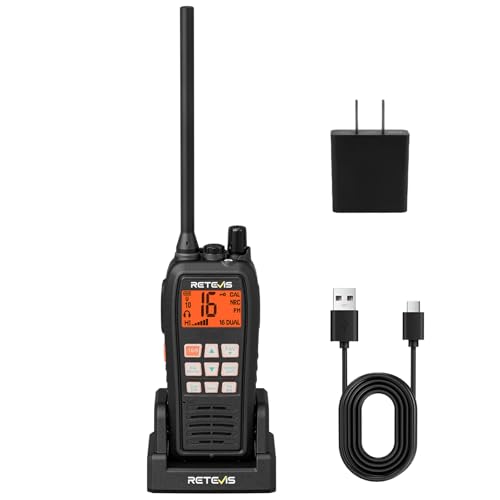
Retevis RM15 6W Marine Radio VHF IP68 Floating
Retevis RM15 6W Marine Radio VHF IP68 Floating, Type-C for Fishing (1 Pack) | 2000mAh Battery,Type-C on Radio & Charger, NOAA, Noise Reduction, Global Channels, Tri-Watch, Offshore Fishing, Travel Spo
Best for: Fishing and offshore trips where Tri-Watch monitoring is useful.
This is a non-Uniden alternative for anglers who want a floating IP68 radio with Type-C charging and a large 2000mAh battery.
Pros
- Floating IP68 body with Type-C charging on both radio and charger.
- Tri-Watch and noise reduction help during busy channel traffic.
Cons
- Not a Uniden product, so menus and accessories differ.
Buying Guide
Waterproofing and Float Design
Marine radios get dropped, splashed, and sometimes fully submerged, so check the ingress protection rating before anything else. Look for an IPX8 or IP68 rating, which indicates the radio is built to handle submersion, and consider whether a floating design matters for your boat or kayak.
A floating radio is a useful safety feature if it falls overboard, since you can recover it without a dive. For sailors and anglers who spend time near the water’s edge, this is often the single most important factor.
Transmit Power and Range
Handheld radios typically range from low-power settings for short hops between boats to higher-power settings for reaching shore stations or other vessels farther away. Some models let you select between several power levels, which helps conserve battery when you do not need full output. Fixed-mount units generally offer higher power than handhelds, so match the radio to how far you expect to transmit.
NOAA Weather Alerts and Channel Coverage
If you head offshore or fish in changeable conditions, NOAA weather alerts can give you early warning of storms and hazardous marine forecasts. Confirm that the radio covers the USA, international, and Canadian marine channels if you plan to cross borders or fish in multiple regions. Channel coverage determines whether the radio can reach the stations and vessels you need.
GPS, Bluetooth, and Extra Features
GPS and Bluetooth add convenience, such as sharing your position during a distress call or pairing with a headset for hands-free use. Emergency features like strobes and flashlights are valuable on night trips or in an emergency. Decide which extras you will actually use so you do not pay for features that sit idle.
Battery Life and Charging
Battery life varies widely, and the advertised runtime depends on how often you transmit and which power level you use. Consider whether the radio uses a rechargeable lithium-ion pack, a standard battery format, or a USB Type-C connection, and whether a charging cradle is included. For a full day on the water, plan to carry a spare battery or a charger you can run from your boat.
FAQ
Do I need a license to use a marine VHF radio?
Licensing rules depend on your country and the type of vessel and radio you operate. In the United States, recreational boaters generally do not need an individual license for handheld marine VHF radios, but you should confirm current requirements with the relevant authority before you head out. Regulations can change, so check before each season.
What does IPX8 mean for a marine radio?
IPX8 is a rating that indicates the radio can be submerged in water beyond a certain depth for a specified time without damage. It is a useful guide for how much abuse a radio can take on a boat. Always follow the manufacturer’s instructions, since ratings apply only when the case is properly sealed.
Can a handheld VHF radio receive NOAA weather alerts?
Many handheld marine radios include NOAA weather channels and an alert function that can sound a tone when a weather broadcast is issued for your area. The exact alert features vary by model, so check the specifications for the NOAA capability you need. Set your location or county code if the radio requires it.
What is the difference between a handheld and a fixed-mount marine radio?
Handheld radios are portable, run on batteries, and are useful for leaving the helm or using in a dinghy. Fixed-mount radios are installed at the helm, draw power from the boat’s electrical system, and generally transmit at higher power for longer range. Many boaters carry both for redundancy.
How long should a handheld marine radio battery last?
Battery life depends on usage, including how much you transmit, the power setting you choose, and whether you use features like Bluetooth or GPS. Standby time is usually much longer than active transmit time. Carry a charged spare or a charging option for multi-day trips.
Is a floating marine radio worth the extra cost?
A floating radio is worth considering if you boat, kayak, or paddleboard near open water, because it can be recovered easily if dropped overboard. If you mostly stay aboard a large vessel with a secure mounting point, a floating design may matter less. Weigh the risk of losing the radio against how you plan to use it.
Conclusion
For boaters who prioritize water survival and easy recovery, a floating, fully submersible handheld with NOAA alerts is the most practical choice, while anglers who want extras like GPS, Bluetooth, and emergency tools may prefer the feature-rich models. Those who need the most transmit range on a larger vessel should look at the fixed-mount option as a complement to a handheld.
Casual weekend boaters on a budget can get reliable coverage from a simpler handheld, while offshore and multi-day trips call for longer battery life, weather alerts, and a spare charging plan. Match the radio to your water conditions and your typical trip length, and the right model will be the one that fits.
Related reading
- VHF Marine Radio Aerials: How to Choose, Mount and Test One (2026)
- Garmin VHF 215 AIS Marine Radio: Setup and Use Guide (2026)
- 4 Best Standard Horizon VHF Marine Radios for Boaters (2026)
- Top 6 Handheld Marine Radios with GPS Models for Boaters
- Top 5 Handheld Marine VHFs with GPS Worth Considering in 2026
About Graham Fisher
Graham Fisher is part of our editorial team and reviews and edits our sailing gear guides, checking product details against manufacturer specifications and owner feedback.
About the author
Graham Fisher writes reviews and buying guides for Sailing The Web.