7 Best Garmin Marine VHF Radio Models for Boaters (2026)
Compare the best garmin marine vhf radio models for boaters. Find the right fixed-mount VHF for AIS, GPS, and DSC needs, with pros, cons, and a buying guide.
 By Graham Fisher
Updated November 21, 2026
 By Graham Fisher
Updated November 2026
Choosing a garmin marine vhf radio comes down to three things: whether you need AIS target tracking, how much fleet-style control you want on the helm, and whether you want a dedicated GPS built into the set. This list compares seven fixed-mount marine VHF options, ordered by how well each one fits those criteria, with a look at power output, display, and integration with existing chartplotters.
Our top picks at a glance
- 1TOP CHOICEBest overallGarmin 0100209700 VHF 215 Marine RadioView on Amazon
- 2
 TOP CHOICEBest for AIS trackingGarmin 0100209800 VHF 215 AIS, Slate Gray with Amp Yellow BandView on Amazon
- 3
 TOP CHOICEBest for basic installsGarmin 0100209600 VHF 115 Marine RadioView on Amazon
- 4
 Best for AIS receive-onlyGarmin Signal VHF 220 Marine Radio and AIS ReceiverView on Amazon
- 5
 Best for hailer and GPSGarmin 0100204700 VHF 315View on Amazon
- 6
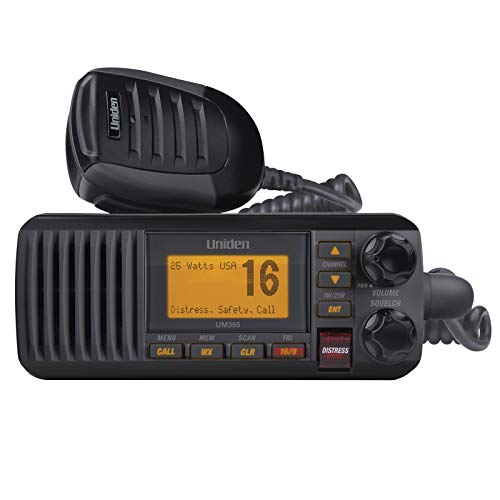 Best for weather alerts on a budgetUniden UM385BK 25 Watt Fixed Mount Marine VHF RadioView on Amazon
- 7
 Best for large displayUniden UM725G Marine VHF Radio, All USA, Canada, and Intl. Marine ChanView on Amazon
Our Top Picks
| Product | Best for | Key feature |
|---|---|---|
| Garmin 0100209700 VHF 215 Marine Radio | Best overall | Full DSC and 25W output |
| Garmin 0100209800 VHF 215 AIS | Best for AIS tracking | Built-in AIS target display |
| Garmin 0100209600 VHF 115 Marine Radio | Best for basic installs | Simple, compact fixed mount |
| Garmin Signal VHF 220 Marine Radio and AIS Receiver | Best for AIS receive-only | AIS receiver with VHF |
| Garmin 0100204700 VHF 315 | Best for hailer and GPS | Modular with hailer and GPS |
| Uniden UM385BK 25 Watt Fixed Mount Marine VHF Radio | Best for weather alerts on a budget | NOAA weather alert |
| Uniden UM725G Marine VHF Radio | Best for large display | Largest LCD in class |
Garmin 0100209700 VHF 215 Marine Radio
Garmin 0100209700 VHF 215 Marine Radio
Best for: Boaters who want a full-featured fixed-mount radio that pairs with a Garmin chartplotter.
This is the general-purpose choice for cruisers and offshore sailors who want DSC calling, a clear display, and room to grow into AIS later.
Pros
- Full DSC functionality
- Rated at 25 watts transmit output
Cons
- No built-in AIS target display
Garmin 0100209800 VHF 215 AIS, Slate Gray with Amp Yellow Band
Garmin 0100209800 VHF 215 AIS, Slate Gray with Amp Yellow Band
Best for: Coastal and offshore boaters who want to see nearby vessels on the radio display.
Owners who run busy shipping lanes or sail at night tend to choose this version for the added AIS target tracking.
Pros
- Built-in AIS target display
- Same DSC and 25W core as the non-AIS model
Cons
- Costs more to set up than a basic VHF
Garmin 0100209600 VHF 115 Marine Radio
Garmin 0100209600 VHF 115 Marine Radio
Best for: Smaller boats and day sailors who need a reliable radio without extra features.
This is a straightforward fixed-mount set for boats that do not need AIS or an integrated hailer.
Pros
- Simple, compact installation
- Clear DSC-capable controls
Cons
- Fewer features than the 215 series
Garmin Signal VHF 220 Marine Radio and AIS Receiver
Garmin Signal VHF 220 Marine Radio and AIS Receiver
Best for: Boaters who want AIS awareness combined with VHF voice in a single unit.
Suited to owners who want to monitor surrounding traffic without the cost of a full transceiver setup.
Pros
- Combines VHF and AIS receive in one unit
- Good fit for monitoring traffic
Cons
- Receive-only AIS does not transmit your position
Garmin 0100204700 VHF 315
GARMIN ELEC. Garmin 0100204700 VHF 315, Modular, with Hailer & GPS, White, Small
Best for: Owners who want a modular radio with an external hailer and built-in GPS.
This model suits larger boats where a deck hailer and onboard position data are useful.
Pros
- Integrated GPS
- Modular design with hailer support
Cons
- More components to install
Uniden UM385BK 25 Watt Fixed Mount Marine VHF Radio
Uniden UM385BK 25 Watt Fixed Mount Marine VHF Radio, Waterproof, Noaa Weather Alert, All USA/Intl/Canadian Marine Channels
Best for: Boaters who want NOAA weather alerts and full US, international, and Canadian channels.
A solid alternative for owners who do not need a Garmin ecosystem but want weather monitoring on a fixed mount.
Pros
- NOAA weather alert function
- Covers USA, Canadian, and international channels
Cons
- Does not integrate with Garmin chartplotters
Buying Guide
AIS Capability
AIS, or Automatic Identification System, shows nearby vessels with their names, speeds, and headings on your display. If you cruise busy waterways, offshore routes, or commercial shipping lanes, an AIS receiver or transceiver is one of the most useful safety features you can add. Receive-only AIS is a good middle ground for many boaters, while a full transceiver also broadcasts your own position.
Fixed-Mount Versus Handheld
Fixed-mount radios are wired into your boat’s power and antenna system, which gives you stronger transmit power and better range than a handheld. They also let you use a speaker or helm microphone so you can keep your hands on the wheel. Handhelds are useful as a backup, but a fixed-mount unit should be your primary radio on most boats.
Display and Helm Control
Look at how easy the screen is to read in bright sunlight and whether the controls can be operated without fumbling. Larger displays and clear menus make a difference when you are managing channels, weather alerts, and distress calls under stress. Some models also support multiple stations or remote mics, which helps on larger boats with more than one helm.
Integration With Your Chartplotter
If you already run a Garmin chartplotter, check whether the radio can share data and be controlled through the network. Integration can simplify your setup by letting you see AIS targets and GPS position on your existing screen. Confirm compatibility with your current electronics before buying so you are not left with features that do not work together.
Weather Alerts and Power Output
NOAA weather channels with alert functions help you stay ahead of changing conditions, especially in coastal and offshore areas. Transmit power matters for range, and many fixed-mount radios let you switch between a low and high setting to save battery when you do not need full output. Choose a power level that matches the distances you typically travel.
FAQ
Do I need an AIS radio if I only boat on inland lakes?
Not necessarily. AIS is most valuable where commercial traffic is heavy, such as large harbors, coastal waters, and offshore routes. On a small lake with little traffic, a basic VHF radio may meet your needs.
Is a fixed-mount radio better than a handheld?
For everyday use on a boat, a fixed-mount radio is generally better because it offers higher transmit power, a stronger antenna connection, and easier operation from the helm. A handheld is a useful backup for emergencies or for use in a dinghy.
What does receive-only AIS mean?
A receive-only AIS unit picks up signals from nearby vessels and displays them on your screen, but it does not broadcast your own position. A transceiver does both, which makes your boat visible to other AIS-equipped vessels. Transceivers are typically preferred for safety on busy water.
Do I need a license to use a marine VHF radio?
Requirements vary by country and by the type of station you operate. In the United States, recreational boaters generally do not need a license for a VHF radio, but you should check current regulations for your area and your specific equipment. Learning proper radio procedure and emergency calling is always recommended.
Can a marine VHF radio get weather updates?
Many models include NOAA weather channels and alert functions that notify you of severe weather in your area. These alerts can be helpful for planning trips and reacting quickly to changing conditions. Make sure the radio you choose covers the weather channels for your region.
Conclusion
If you want the most complete safety picture, especially on busy or offshore water, a model with AIS transceiver capability and strong integration with a chartplotter is the best fit. Boaters who mainly need reliable voice communication and weather alerts on a budget will find that a simpler fixed-mount radio covers the essentials well.
For smaller boats and casual day use, a basic fixed-mount unit with good display and weather alerts is often enough. Match the radio to where you boat, how many people share the helm, and how much electronics integration you already have, and you will end up with a set that serves you well season after season.
Related reading
- Garmin VHF 215 AIS Marine Radio: Setup and Use Guide (2026)
- VHF Marine Radio Aerials: How to Choose, Mount and Test One (2026)
- 4 Best Standard Horizon VHF Marine Radios for Boaters (2026)
- Top 6 Handheld Marine Radios with GPS Models for Boaters
- Top 5 Handheld Marine VHFs with GPS Worth Considering in 2026
About Graham Fisher
Graham Fisher is part of our editorial team and reviews and edits our sailing gear guides, checking product details against manufacturer specifications and owner feedback.
About the author
Graham Fisher writes reviews and buying guides for Sailing The Web.